What Is PDRN Skincare, and Does It Work?
PDRN skincare is made with fragments of DNA, often taken from salmon or trout sperm, and it's being studied for a possible role in skin repair.1 It's an unlikely thing to put on your face, but the early human studies are encouraging. Small trials of PDRN creams have reported measured changes in wrinkles, elasticity and recovery after irritation.2, 3 Each result, though, belongs to one particular cream, tested in 31 people or fewer for about a month, so PDRN is promising rather than proven. If you're considering a PDRN product, check whether it's the formula that was actually tested.
What's actually in a PDRN cream?
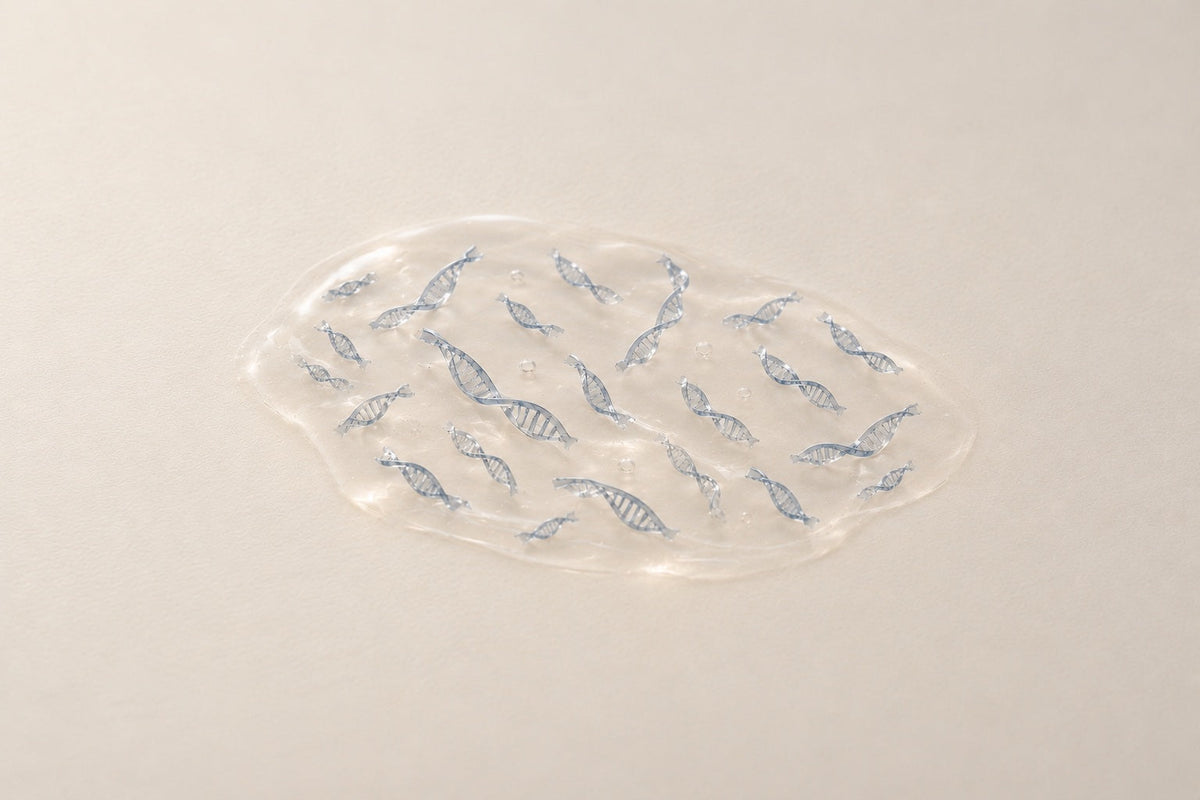
DNA is the molecule that carries genetic information in living cells, and PDRN, short for polydeoxyribonucleotide, is a preparation of fragments of it. Preparations vary in where the DNA comes from and how long its chains are.1
Fish sperm isn't the only source. One recent human trial used salmon-derived PDRN, and another tested a preparation from peony, a flowering plant.1, 2, 3 Because they share a name, the salmon and peony preparations can seem interchangeable, but a result for salmon PDRN doesn't tell you how peony PDRN would perform.
You may also see PN, short for polynucleotides. If the naming sounds muddled, a 2025 review agrees. It found PDRN and PN used inconsistently in the scientific literature and proposed telling them apart by the length of their DNA chains. That's a proposal, though, not a naming rule every study already follows.1
Why would DNA fragments help skin?
The interest comes from research into how cells respond to PDRN. A scientific review describes possible effects on cell signals involved in repair, and on cells reusing DNA's building blocks.1 These are proposed mechanisms. They give researchers reasons to test PDRN for skin repair, but they aren't evidence that it works.
Can a cream deliver it?
A promising ingredient still has to reach the tissue it's meant to affect, so the delivery method plays an important role in whether it's effective. The skin's outermost layer forms a barrier between an applied product and the living layers beneath it. An ingredient applied to the surface has to cross the barrier first, while an injection skips the step.2 Think of a tightly woven raincoat over the living skin. So a leave-on cream has to be judged in its own formula and the way it's used.
Results for injected PDRN don't settle the question for creams. In a small trial of PDRN for pressure ulcers, both groups got standard wound care, and one group also got PDRN injected into muscle and around the wounds. Its wound measurements improved more over four weeks.4 That was a medical study of damaged tissue, though. A cream applied to intact skin to improve wrinkles is a different treatment, measured by a different outcome.
For creams, the delivery evidence is thin. Experiments accompanying one trial suggest PDRN passes into skin, but the human tracing experiment involved only one volunteer. It also couldn't conclusively tell applied PDRN apart from the skin's own DNA and related molecules.2 So whether PDRN gets into skin is a question for each formula, not a settled yes or no for the whole category.
Does a PDRN cream work in people?
The most direct evidence on whether a PDRN cream works comes from a 2026 trial of an eye cream. Thirty-one Chinese women with sensitive skin and lines around their eyes took part. Each used a 0.1% salmon-derived PDRN eye cream on one side of the face and a 0.1% retinol eye cream with an identical base on the other, for 28 days. Neither the women nor the researchers knew which cream was which.2 Using one side of each face for each cream lets every woman serve as her own comparison. But both creams were active, and no group used the base cream alone.
By day 28, image analysis found roughly 20–23% reductions in crow's-feet wrinkle area and number on the PDRN side, compared with roughly 6–7% on the retinol side. The study also reported favorable changes in instrument-measured firmness and elasticity, and in ultrasound measures of skin structure.2 A margin like that over retinol in four weeks is striking. It's also easy to read more into it than the trial allows.
It's direct human evidence for a PDRN cream, but it doesn't show that PDRN generally outperforms retinol. The trial tested two particular creams for four weeks. Using 0.1% of each ingredient doesn't make them equally powerful. The paper also notes that clearer changes in skin tissue in retinoid research have generally been measured over longer periods.2 So four weeks may favor whichever ingredient shows its effects sooner.
Because the creams shared a base, the moisturizer itself is a less convincing explanation for the difference between the two sides. With no base-only group, though, the trial can't say how much either active ingredient added to the base. The authors also acknowledge that hydration and plumping could contribute to early ultrasound changes. Telling those apart from lasting collagen rebuilding will take longer follow-up.2
Several of the authors had commercial affiliations.2 Independent replication would make the early findings more convincing, and how noticeable or lasting the cream's benefits would be across a wider population is still unsettled.
Does the second study back it up?
A second study tested a different preparation. Ten healthy Korean participants used a cream containing 1% low-molecular-weight PDRN from peony (meaning shorter DNA fragments), and the researchers compared it with a formula without the PDRN. After four weeks, an instrument-measured elasticity score around the eyes rose from 69.22 to 72.16 with the test cream, while the control changed little.3
A rise of about three points sounds clear, but it compares the test cream with its own starting measurement. The comparison with the starting measurement was the one reported as statistically significant, and the reported test didn't establish that the test cream did better than the control. Even a real difference in an elasticity score wouldn't automatically mean a noticeable improvement in wrinkles.3
The researchers also tested how skin recovers after being deliberately irritated, using sodium lauryl sulfate on upper-arm skin. Over two weeks, water loss through the skin fell with both creams, with a larger reduction reported for the peony cream. The test measures how the barrier recovers after induced irritation, which is a different question from everyday use on your face.3
So the peony study adds an early signal for a different preparation under different conditions, rather than repeating the salmon eye-cream test. It also followed people only briefly, comes from a commercially affiliated team, and leaves details of random assignment and blinding unclear.3 Neither cream study reported adverse reactions in its participants. That can't establish safety for everyone, though, because small, short studies can't settle uncommon or long-term risks.2, 3
What to look for
If you're considering a PDRN product:
- Check which PDRN preparation it contains, including where the DNA comes from.
- Check whether the product's finished formula was tested, not just the ingredient. If the preparation matches a study but the cream base is different, you're looking at a different product.
- Read its results as early findings from small, short studies of particular creams.
Sources
- Marques C, et al. From Polydeoxyribonucleotides (PDRNs) to Polynucleotides (PNs): Bridging the Gap Between Scientific Definitions, Molecular Insights, and Clinical Applications of Multifunctional Biomolecules. Biomolecules, 2025.
- Ye R, et al. Topical medium-length PDRN enhances dermal extracellular matrix repair in photodamaged skin via PI3K–Akt/TGF-β–regulated pathways. PLOS One, 2026.
- Bak SU, et al. Anti-Aging Efficacy of Low-Molecular-Weight Polydeoxyribonucleotide Derived from Paeonia lactiflora. International Journal of Molecular Sciences, 2026.
- Kim JY, et al. Effects of Polydeoxyribonucleotide in the Treatment of Pressure Ulcers. Journal of Korean Medical Science, 2014.