What Is a Solid Serum? How It Works and Why We Chose It
The oil inside a solid serum is still liquid. A network built by a gelling ingredient holds it in place, so the serum keeps its shape in the jar instead of pouring, and warmth and rubbing soften the network as you spread it, which lets the blend glide across your skin.1, 2 On a label, "solid serum" describes a texture and a role in your routine, and the oils and actives inside decide what the product actually does.
How does liquid oil hold its shape?
A gelling ingredient forms a network that holds the oil in place, much the way gelatin holds juice in a jelly, and the result is called an oil gel.2
Wax is one way to build the network. In experiments with soybean oil, adding more sunflower wax raised the gel's melting point, and changing how quickly the gel cooled changed its firmness.1 So the texture depends on both the recipe and how the blend is made. Even the cooling speed shows up in the finished product.
How is it different from a balm, a face oil or a cream?
A face oil stays fluid, while a balm often holds oils in a firm or partly solid structure. An oil-based solid serum can be built much like a balm, and the name "solid serum" describes its texture and the role it's meant to play in skincare.
A cream usually combines oil and water. Ingredients called emulsifiers help keep tiny drops of oil spread through water, or of water through oil, forming an emulsion, which gives water-soluble and oil-soluble ingredients a place in the same formula.6
| Format | How it's usually built | What happens during application |
|---|---|---|
| Face oil | A flowing oil or oil blend | Dispensed as a liquid and spread directly across skin |
| Balm | Often an oil base held in a firm or partly solid structure | Picked up and spread; warmth and rubbing can soften the structure |
| Solid serum | A firm or partly solid product intended for use as a serum | Picked up and spread; an oil-based version can behave much like a balm |
| Cream | Oil and water held together as an emulsion | The oil and water spread across skin together |
The guide to anhydrous and water-based serums explains how including water changes the ingredients a formula can carry.
What makes it easy to spread?
Warmth can soften or melt a solid serum's structure, a bit like butter on warm toast. Some oil gels also flow more easily when rubbed, so the blend can spread while part of its structure stays in place.1, 2
The oils inside the structure matter too. Emollients are ingredients that soften and smooth skin, and their resistance to flow is called viscosity. Tests of cosmetic emollients on a skin substitute found that viscosity strongly influenced how far they spread.3
A blend can glide easily across skin and still leave a noticeable sheen. In a study of liquid emollients, people rated ease of spreading, shine, stickiness and oiliness as separate qualities.4 So "easy to spread" and "not shiny" are two different things to look for when you try a solid serum.
How does the base carry active ingredients?
An active ingredient needs a base that suits it. Tetrahexyldecyl ascorbate, or THD ascorbate, is a form of vitamin C that dissolves in oil, so an oil base can carry it, either as a fluid blend or structured into an oil gel. Bakuchiol and bisabolol also fit an oil-based formula.2, 5
The recipe sets each active's concentration, but after you apply the serum, each active still has to leave the base to move into skin's outer layers. A good base has to hold on to an active in the jar and let go of it on your skin, so formulators consider both how well a base holds an active and how readily it releases it.7
The vitamin C comparison goes further into ingredient form and delivery.
Why we chose a solid serum format for Omnia
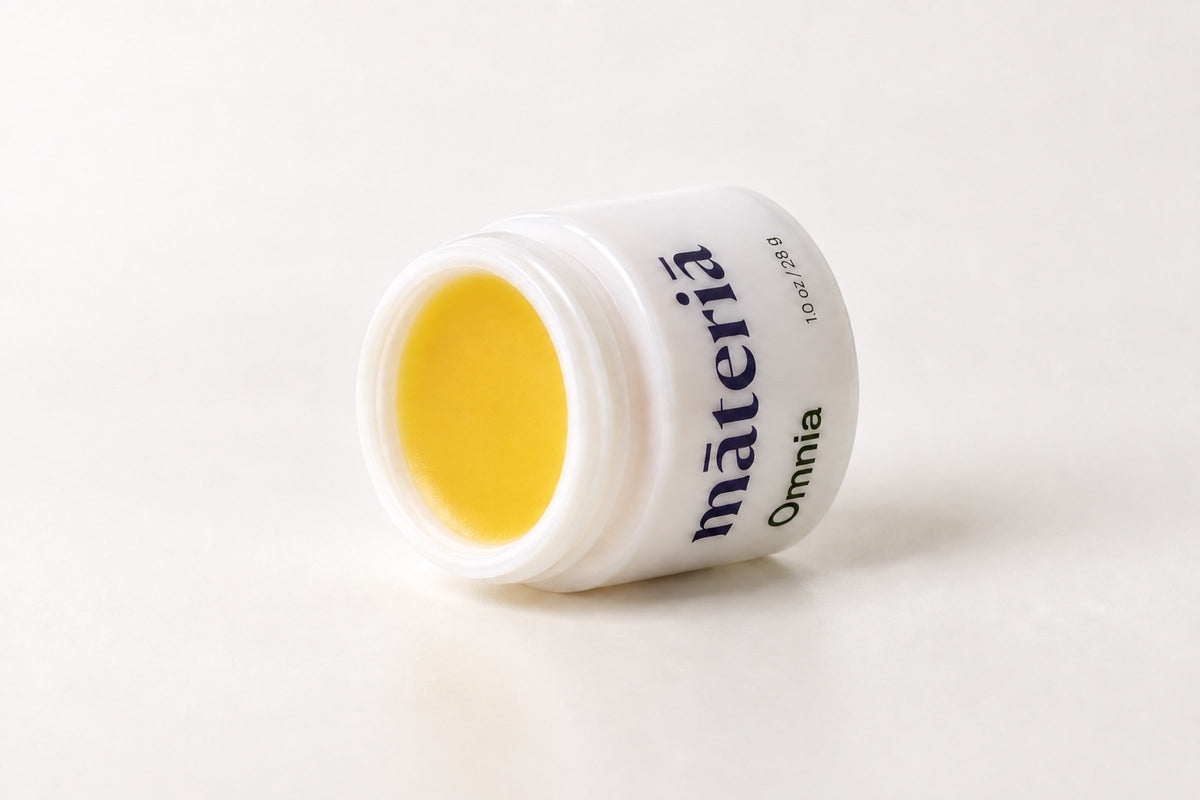
We designed Omnia to combine the richness of a balm with the light finish of a serum. It holds its shape in the jar, is easy to pick up, and melts quickly as you spread it. We chose a waterless base to make room for oil-compatible actives alongside the moisturizing lipids.
THD ascorbate brings an oil-soluble form of vitamin C into the blend. We chose bakuchiol for smoother-looking skin and a more even tone, and bisabolol for its soothing role.8 Ceramide NP adds a barrier lipid.
Sunflower wax and other structuring ingredients hold the liquid blend in place. Within the wax structure, squalane and lighter emollient esters give the base its glide and help create the light finish. We customized the base around the actives, with the goal of helping them leave the formula and reach deeper into skin.
When you try any solid serum, judge how it spreads and how it finishes separately.
Sources
- Hwang HS, et al. Organogel Formation of Soybean Oil with Waxes. Journal of the American Oil Chemists' Society, 2012.
- Pârvănescu (Pană) RD, et al. Oleogel Formulations for the Topical Delivery of Betulin and Lupeol in Skin Injuries: Preparation, Physicochemical Characterization, and Pharmaco-Toxicological Evaluation. Molecules, 2021.
- Douguet M, et al. Spreading properties of cosmetic emollients: Use of synthetic skin surface to elucidate structural effect. Colloids and Surfaces B: Biointerfaces, 2017.
- Parente ME, et al. Study of sensory properties of emollients used in cosmetics and their correlation with physicochemical properties. Journal of Cosmetic Science, 2005.
- Swindell WR, et al. Tetrahexyldecyl Ascorbate (THDC) Degrades Rapidly under Oxidative Stress but Can Be Stabilized by Acetyl Zingerone to Enhance Collagen Production and Antioxidant Effects. International Journal of Molecular Sciences, 2021.
- Cox R. Cold Processing of Emulsions. Technical article, Cosmetics & Toiletries. August 8, 2013.
- Barnes TM, et al. Vehicles for Drug Delivery and Cosmetic Moisturizers: Review and Comparison. Pharmaceutics, 2021. Free full text.
- Dhaliwal S, et al. Prospective, randomized, double-blind assessment of topical bakuchiol and retinol for facial photoageing. British Journal of Dermatology, 2019.